
Professional Stump Grinding & Removal Services: Complete Stump Elimination for Property Enhancement
Removing stubborn tree stumps and roots restores safety, aesthetics, and usable land on residential and commercial properties. This article explains professional stump grinding and stump removal in practical terms, outlining the equipment, process steps, cost drivers, safety protocols, and post-job site restoration so property owners can make informed decisions. Many homeowners and property managers face hazards from exposed stumps, pest attraction, and limited landscaping options; professional stump elimination provides a fast, durable remedy that readies sites for new planting or construction. Below we define stump grinding, compare it to full stump removal, detail the tools and timelines involved, present cost factors with example pricing tables, and describe the step-by-step workflow and safety measures used by trained crews. Keywords such as tree stump removal, stump grinding, stump removal estimate, and stump grinder equipment are woven through this guide to help readers locate the specific information they need when planning a project.
What Is Professional Stump Grinding and How Does It Work?
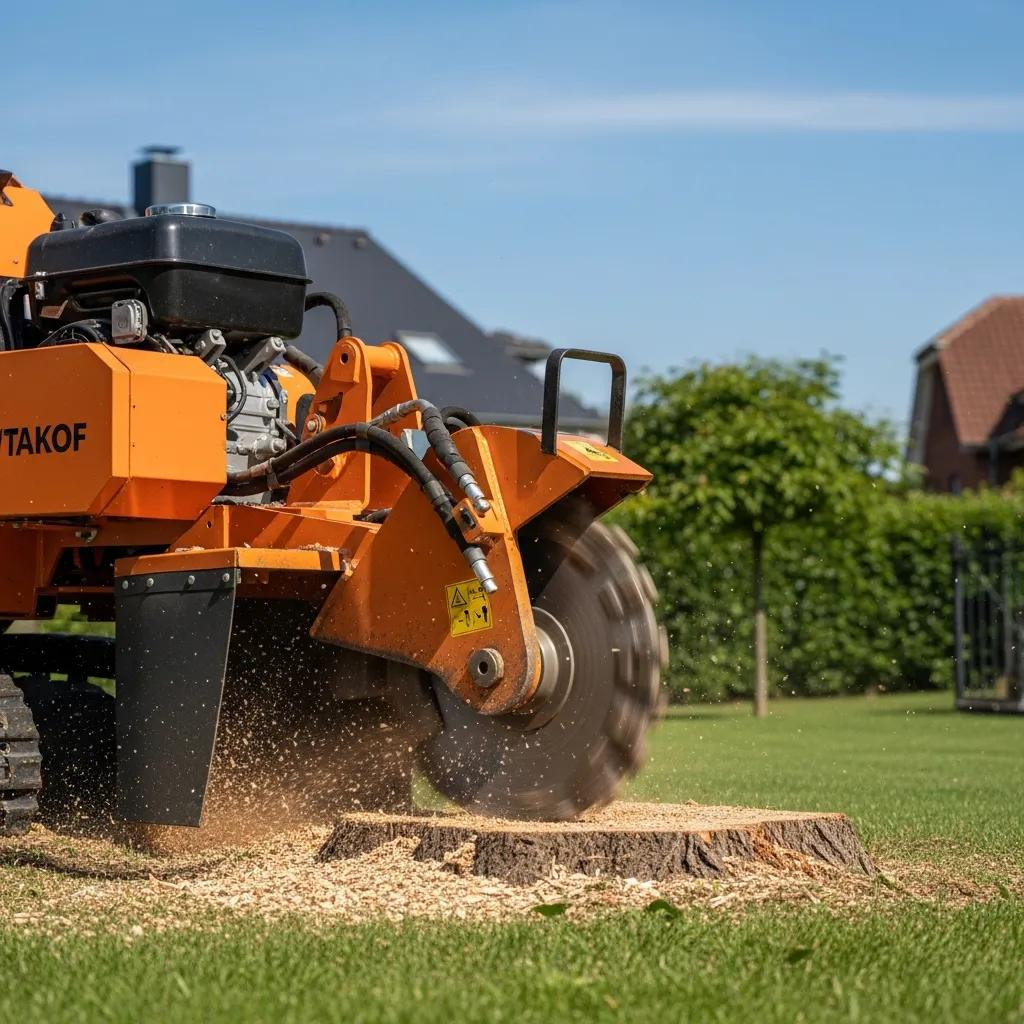
Professional stump grinding is a mechanical process that reduces a tree stump and upper roots to wood chips by using a rotating cutting disc on a stump grinder, producing a flush, regrade-ready surface. Technically, grinding removes the visible stump and part of the root collar to a specified depth, which prevents most regrowth and eliminates tripping hazards while leaving the larger root mass undisturbed deeper in the soil. The mechanism relies on a high-torque cutting wheel with tungsten carbide teeth that chips wood into mulch while operators control depth and orientation for safety and effectiveness. Typical results include a grind depth of several inches to a foot below grade, a pile of wood chips useful for mulch, and a site prepared for backfilling and landscaping. Understanding how equipment class and access shape results leads directly into the equipment types commonly used for this work and the sizing choices crews make.
Professional providers schedule an initial assessment to confirm stump diameter, accessibility, and desired grind depth before deploying equipment and crew. Henry’s Tree Service is a local tree care company specializing in professional stump grinding and removal services, and they perform on-site evaluations to match equipment to each job for efficient stump elimination.
| Equipment Type | Typical Power/Capacity | Common Use Case |
|---|---|---|
| Walk-behind grinder | 20–40 HP equivalent; compact | Small residential stumps in tight yards |
| Tow-behind grinder | 40–80 HP equivalent; mid-range | Multiple mid-size stumps and light commercial sites |
| Large commercial grinder | 80+ HP equivalent; high torque | Large diameter stumps and heavy commercial projects |
This equipment comparison shows how machine class maps to job scale and access constraints, helping property owners anticipate observable outcomes and cleanup needs.
How Does Stump Grinding Differ from Stump Removal?
Stump grinding and stump removal produce different site outcomes because grinding chips the visible stump and upper roots while stump removal extracts the entire root ball and major roots, often using trenching or excavation equipment. Grinding is typically faster, less disruptive to surrounding soil and hardscapes, and less expensive because it leaves deeper roots intact, while full removal is more invasive, requires heavy machinery, and creates a larger disturbance footprint that may need substantial backfilling.
For example, a medium residential stump is often ground to below grade in under an hour, whereas full removal using excavation may take several hours and require heavy equipment access. Choosing between methods depends on final land use: grinding is ideal for lawn restoration and planting, while full removal is preferable where future foundations or paved surfaces will be installed. Understanding these trade-offs clarifies which approach best meets safety, aesthetic, and construction requirements.
Research further highlights the operational and economic considerations involved in mechanized stump extraction, particularly in sectors like forestry.
Mechanized Stump Removal: Performance & Costs
Stump extraction can be carried out in different ways, among which the mechanized removal is the most usual in the forestry sector. Information regarding the operation with cutting implements is important in the context of decision taking, operational and economic optimization of the activity. The objective of this work was to evaluate the operational performance and mechanized costs of different stump extractors implements in an eucalyptus harvested area.
OPERATIONAL PERFORMANCE AND COSTS OF MECHANIZED STUMP EXTRACTION SETS, AGC Lopes, 2020
What Equipment Is Used in Stump Grinding Services?
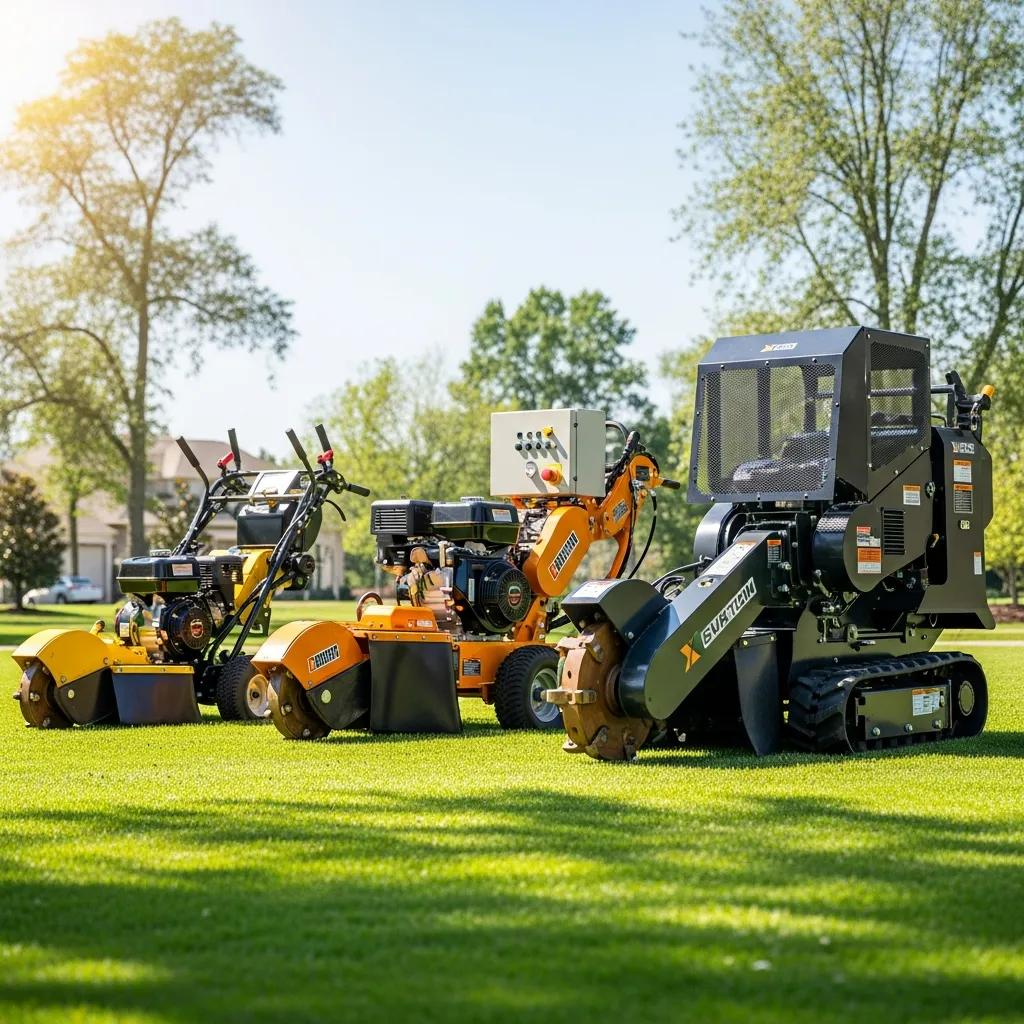
Stump grinding teams use a combination of stump grinders, chainsaws, rakes, and safety gear to complete jobs efficiently and safely, selecting grinder class based on stump diameter and site access. Walk-behind grinders fit narrow entrances and confined yards, tow-behind machines balance power and mobility for multiple stumps, and large commercial grinders deliver the torque needed for very large trunks; crews supplement grinders with chainsaws for root collars and hand tools for chip spreading.
Operators rely on protective guards, hearing protection, eye shields, and exclusion zones to manage flying debris while a chip pile forms for reuse or removal. Image alt text for a grinder photo should describe the machine class and visible safety measures to improve accessibility and search relevance. Knowing the right equipment supports accurate estimates and reduces surprises during the job.
What Are the Key Benefits of Professional Stump Removal?
Professional stump removal delivers measurable improvements in safety, aesthetics, pest control, and usable property area by eliminating physical hazards, improving curb appeal, and reducing habitat for wood-feeding pests. Removing stumps reduces tripping risks that commonly lead to yard injuries and liability claims, opens otherwise unusable spaces for landscaping or construction, and enhances property appearance for resale or daily enjoyment. The biological benefit comes from removing the root collar and reducing cellulose food sources that attract termites, carpenter ants, and wood-boring insects, lowering pest pressure near structures. Each of these outcomes contributes directly to property value and usability, making stump elimination a practical investment for homeowners and commercial property managers alike.
| Benefit | Mechanism/Attribute | Value to Property Owner |
|---|---|---|
| Safety improvement | Eliminates trip hazards and hidden roots | Reduced injury risk and liability exposure |
| Aesthetic enhancement | Removes unattractive remnants and enables grading | Enhanced curb appeal and usable landscape area |
| Pest prevention | Removes decaying wood that attracts pests | Lower pest pressure around buildings |
| Landscape readiness | Creates a stable, rock-free planting surface | Faster site preparation for new installations |
These benefit mappings show how specific removal attributes translate into direct homeowner advantages and inform whether a project should focus on grinding depth, chip removal, or full root extraction.
How Does Stump Removal Improve Property Safety and Aesthetics?
Removing stumps reduces tripping hazards, eliminates uneven lawn contours, and prevents root resurgence that can distort driveways or sidewalks, thereby improving both safety and the property’s visual appeal.
In playgrounds, pool areas, or high-traffic yards, a flush, ground-level surface dramatically lowers accident risk and simplifies mowing and maintenance tasks. Aesthetic improvements extend to better sightlines, more consistent turf growth, and the ability to plant new trees or install patios without the interference of remaining stumps. These practical outcomes also affect perceived property value, since buyers and appraisers favor clear, usable landscapes. Understanding how safety and aesthetics interact helps prioritize grind depth and cleanup options during planning.
How Does Stump Grinding Prevent Pest Infestations and Regrowth?
Stump grinding interrupts the biological processes that support pests and prevents vegetative regrowth by removing the root collar and exposing wood to oxidation and decomposition, which reduces long-term attractiveness to termites and ants. Grinding to a sufficient depth eliminates the cambium and upper root tissues that can sprout, while timely chip removal or proper chip redistribution reduces sheltered, moist habitats favored by wood-boring insects. Leaving chips in place can serve as mulch if spread thinly and dried, but piled chips near foundations can attract pests and should be managed accordingly. Proper grind depth and chip handling together create conditions that discourage regrowth and lower pest risk around structures.
How Is the Cost of Tree Stump Grinding and Removal Determined?
Stump grinding and removal costs are driven by measurable attributes—stump diameter, tree species and root hardness, accessibility, number of stumps, and disposal or site restoration requirements—which together determine labor time and equipment needs. Typical pricing models include per-inch rates, flat minimum fees, and bundled discounts for multiple stumps; a common ballpark for per-inch grinding ranges from $2 to $5 per diameter inch but varies significantly by market and access. Accurate on-site estimates are important because photos and measurements alone may not reveal root complexity or hidden access barriers. After clarifying cost drivers below, property owners should Request a Free Estimate or Get an Accurate Site Estimate from a local provider to receive a tailored price that reflects actual site conditions.
| Stump Attribute | Pricing Factor | Typical Value/Range |
|---|---|---|
| Diameter | Linear increase per inch | Example: small (6–12″) to large (36″+) scales proportionally |
| Tree species | Root hardness affects time | Hardwoods cost more due to slower cutting |
| Accessibility | Time and equipment setup | Tight yards increase labor and may require smaller machines |
| Number of stumps | Volume discounts or per-stump fees | Multiple stumps typically lower per-stump cost |
This table clarifies how physical characteristics map to pricing influences and why transparent quotes should itemize these factors.
Intro to common pricing considerations with examples:
- Accessibility and proximity to structures often increase mobilization time and risk mitigation measures.
- Large diameters require high-torque machines or additional passes, increasing labor and wear on cutting teeth.
- Disposal, chip hauling, and backfilling add to total job cost and should be included in estimates.
What Factors Influence Stump Grinding and Removal Pricing?
Several clear factors shift pricing up or down, including stump diameter, species and root density, site accessibility, nearby utilities or hardscapes, and required cleanup or restoration services. Larger diameters increase cutting time and wear on grinder teeth, while species such as dense hardwoods require more passes and slower feed rates. Restricted access forces crews to use smaller, less efficient grinders or more manual labor, and proximity to structures requires tighter safety protocols that add time. Each factor interacts, so a single-site estimate that considers all variables provides the most accurate price projection.
How Can I Get an Accurate Stump Removal Estimate?
To obtain an accurate estimate, provide several clear photos showing scale and access points, measure stump diameters at ground level if possible, and describe any surrounding landscaping, hardscapes, or underground utilities. A reputable provider will perform an on-site inspection to confirm root spread, verify access routes for equipment, and outline disposal, chip handling, and restoration options in their written estimate. Ask for a breakdown of labor, equipment, disposal, and any additional services like backfilling or hauling to understand the full scope. Requesting a Free Estimate from a local specialist ensures the quote reflects actual conditions rather than an online ballpark number.
What Is the Step-by-Step Process of Professional Stump Grinding?
Professional stump grinding follows a predictable sequence: site assessment and marking, safety setup and exclusion zones, mechanical grinding to targeted depth, chip management and optional backfill, and final grading and cleanup. Each phase serves a defined role: assessment verifies suitability and identifies hazards, safety setup protects people and property, grinding achieves the desired removal depth, and restoration readies the site for future planting or construction. Typical durations vary by stump size and access, but many single-stump jobs complete within one to three hours; multi-stump or large-diameter projects extend accordingly. Operators document site conditions and recommended follow-up to ensure the owner understands restoration choices and timelines.
- Site assessment and hazard identification to plan equipment and safety.
- Safety setup including PPE, barriers, and rooting out obstacles.
- Mechanical grinding to the designated depth with controlled passes.
- Chip management, optional backfilling with topsoil, and final grading.
What Safety Measures Are Taken During Stump Grinding?
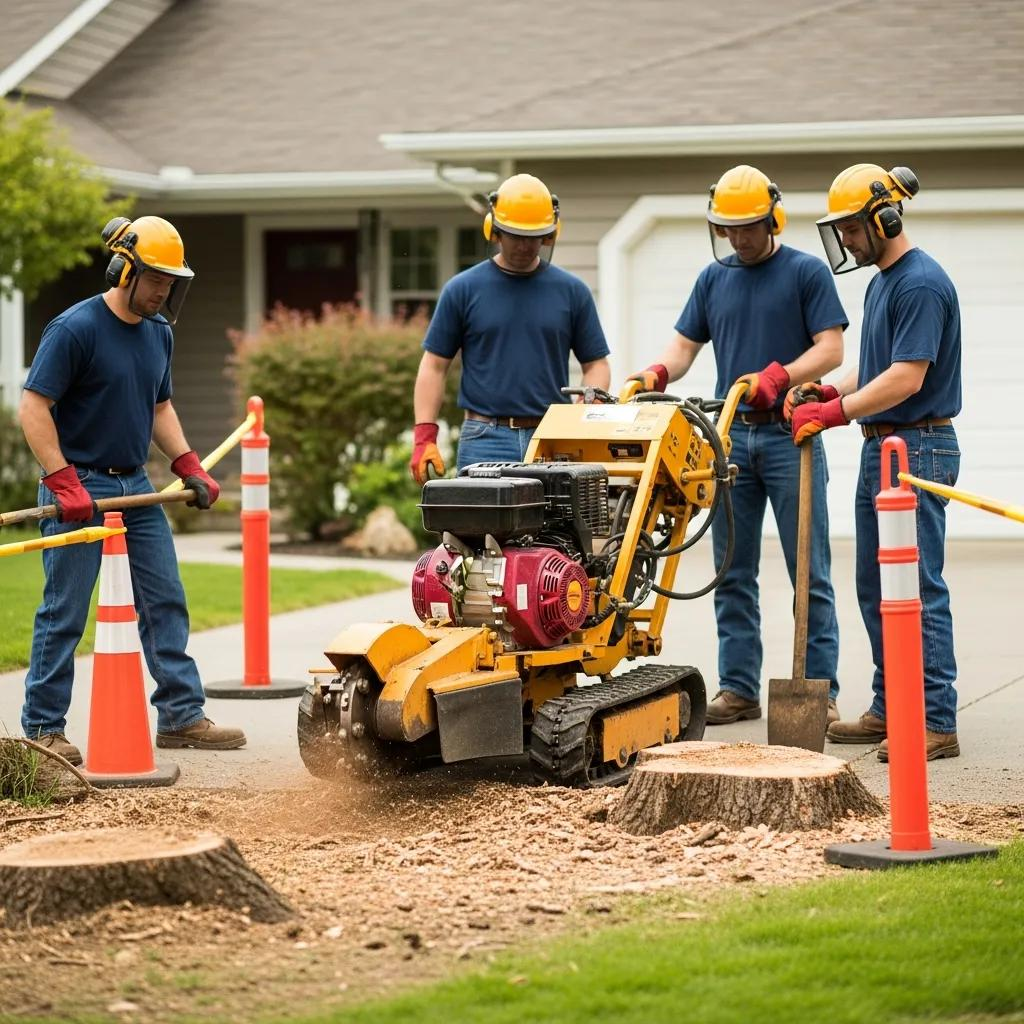
Safety measures for stump grinding include personal protective equipment (PPE) for operators, establishing exclusion zones to protect bystanders, using machine guards and remote controls when available, and verifying underground utilities or irrigation lines before cutting. Operators wear eye protection, hearing protection, gloves, and protective footwear, and crews use cones or tape to mark safe distances; these protocols reduce injury risk from flying debris and machine operation. Pre-job hazard assessment identifies brittle roots that can snap unpredictably and locates buried infrastructure to prevent accidental damage. Rigorous adherence to safety protocols preserves property integrity and ensures faster job completion with fewer interruptions.
How Is Site Restoration and Cleanup Managed After Stump Removal?
After grinding, crews offer options for chip reuse, chip removal, backfilling, and final grading to match the owner’s restoration goals, balancing cost and convenience. Leaving chips in place can provide immediate mulch benefits if spread thin and integrated into beds, while chip removal avoids potential pest habitats and supports clean turf reinstatement. Backfilling the hole with topsoil and compacting in layers prepares a smooth surface for sod or planting; contractors often recommend a short settling period before planting heavy-rooted species. Final grading and seeding or sodding timelines depend on seasonality but typically follow within a few days to weeks based on site conditions and owner preference.
Why Choose Henry's Tree Service for Your Stump Grinding Needs?
Henry’s Tree Service specializes in professional stump grinding and removal services and matches equipment class to each site’s specific needs to deliver efficient, predictable stump elimination. As a local tree care company focused on stump grinding and removal, Henry’s Tree Service conducts on-site evaluations to determine grind depth, machine selection, and chip management options that minimize landscape impact and optimize outcomes. Their approach emphasizes transparent estimates and clear restoration choices, enabling property owners to weigh grinding depth, chip reuse, and backfill options without surprises. For property owners seeking straightforward next steps, Request a Free Estimate or Get an Accurate Site Estimate to discuss project scope and restoration preferences with a local specialist.
Intro to qualifications and equipment capabilities before detailing specifics in H3s.
What Qualifications and Experience Do Our Arborists Have?
Henry’s Tree Service engages experienced crews trained in safe stump grinding techniques, equipment operation, and site restoration practices typically required for professional tree care work. While specific certifications are not listed here, the team’s focus on stump grinding and removal reflects practical experience in matching equipment to job complexity and managing safety protocols around structures and utilities. Field experience informs realistic time estimates, chip handling recommendations, and restoration sequencing that help property owners plan subsequent landscaping or construction. Prospective customers should inquire during their estimate about training, insurance, and safety practices to confirm alignment with project risk profiles.
How Does Our Advanced Equipment Ensure Efficient Stump Elimination?
Using the appropriate class of stump grinder ensures deeper, faster cuts with reduced passes, which lowers labor time, minimizes property impact, and produces a cleaner final surface ready for backfilling or planting. Walk-behind machines allow access to tight spots without heavy disturbance, tow-behind grinders cover mid-size jobs efficiently, and commercial grinders tackle large diameters with high torque and faster throughput. This equipment diversity lets crews choose the tool that balances speed and precision, reducing unnecessary soil disruption and lowering overall project time. Image alt text for equipment should describe the machine class and intended stump range to aid accessibility and clarity.
Comprehensive Guide to Professional Stump Grinding & Removal
Property owners commonly ask about job duration, DIY feasibility, chip disposal, and how grinding affects future planting; concise, direct answers help set expectations and guide decisions. Addressing common questions with short, clear responses reduces confusion and supports faster planning for permits, schedules, and restoration. Below are direct answers to typical queries with practical guidance.
Common quick answers:
- Timeframes for single stumps often range from 30 minutes to 2 hours depending on diameter and access.
- DIY is possible for very small stumps but carries safety risks and may be inefficient compared with professional equipment.
- Chips can be reused as mulch, removed for disposal, or spread thinly for soil amendment depending on owner preference.
- Cost estimates require physical inspection for accurate pricing due to hidden root complexity and access variables.
How Long Does Stump Grinding Usually Take?
A typical single-stump grinding job often takes between 30 minutes and two hours, depending on stump diameter, root complexity, and site accessibility, with larger or multi-stump jobs taking longer. Small stumps in open yards are ground quickly with walk-behind machines, while large stumps demand multiple passes with higher-capacity grinders and additional safety setup time. Accessibility constraints that require manual staging or smaller machines can extend total labor hours and increase the overall schedule. For planning purposes, expect modest jobs to be completed the same day, while larger projects may be scheduled over multiple sessions.
Can I Remove a Tree Stump Myself or Should I Hire Professionals?
DIY stump removal options include manual digging, chemical rotting, or renting small grinders, but these approaches have trade-offs in safety, time, and effectiveness compared with professional services. Manual removal is labor-intensive and can damage nearby utility lines or hardscape, while chemical methods take months and may not fully eliminate roots. Renting a grinder can work for small stumps if the operator is experienced and follows safety protocols, but large or root-complex stumps are best handled by trained crews equipped to manage debris, depth, and restoration. For larger stumps, limited access, or projects near structures, hiring professionals ensures safer, faster, and more durable results.