
Master North Carolina Tree Identification: Your Essential Guide to Species and Care
Ever found yourself gazing up at a tree in North Carolina, curious about its specific identity? Having a reliable guide to identifying NC trees empowers homeowners and property managers with the knowledge to understand leaf patterns, bark textures, seasonal changes, and more. This insight leads to better tree health, enhanced property aesthetics, and the confidence to make informed care decisions. In this comprehensive guide, you’ll learn effective identification techniques, how to distinguish common deciduous and evergreen species, discover top native trees perfect for landscaping, recognize when professional arborist services are crucial, and find the best resources, both digital and print. While our examples focus on North Carolina’s rich arboreal diversity, the principles we cover apply directly to the properties we serve in Western Massachusetts and Connecticut, ensuring you receive expert support from Henry’s Tree Service every step of the way.
What Are the Best Methods to Identify Trees in North Carolina?
Identifying trees involves observing key characteristics like leaves, bark, twigs, flowers, and fruits, combined with systematic tools for accurate species recognition and informed care. By using a dichotomous key, examining leaf morphology, analyzing bark texture, and noting seasonal cues, you can quickly understand a tree’s health and maintenance requirements.
Professional arborists often start with a dichotomous key, then confirm their findings through direct observation before recommending services like pruning, disease management, or removal. Employing these methods ensures swift identification and grounds all subsequent service decisions in precise botanical knowledge.
How Does a Dichotomous Key Help Identify North Carolina Trees?

A dichotomous key simplifies tree identification by presenting a series of paired choices. It guides you through characteristics such as leaf shape and arrangement, systematically narrowing down possibilities to pinpoint the species. This process accelerates recognition and removes guesswork, moving from broad categories like simple versus compound leaves to specific details like serration patterns, ensuring reliable results even for beginners.
How Can You Identify Trees by Their Leaves in North Carolina?
Leaf identification relies on observing shape, margin, arrangement, and texture. These features allow for quick differentiation between species like maples, oaks, and sweetgums, which is essential for landscape planning and maintenance. Distinguishing between opposite and alternate leaf arrangements, or smooth versus serrated margins, helps guide you to the correct genus, while compound leaf structures often indicate hickories or ashes.
What Bark Characteristics Are Key to Tree Identification in NC?
A tree’s bark texture, color, and pattern change as it matures, providing crucial clues for identification, especially when leaves are absent. The smooth, silver bark of a young American beech is distinct from the deeply furrowed ridges of a mature oak, while the peeling, cinnamon-colored bark is a hallmark of the river birch.
How Do Twigs, Buds, Flowers, and Fruits Aid in Tree Identification?
The thickness of twigs, the orientation of buds, the appearance of flower clusters, and the type of fruit offer additional layers of confirmation, boosting confidence in species determination. The shape of bud scales can differentiate a maple from an ash, and the presence of springtime catkins or samaras can confirm an alder or maple, respectively.
What Seasonal Tips Improve Tree Identification Accuracy in North Carolina?
Seasonal changes reveal unique tree traits that aid year-round identification. Think of the vibrant fall color of a red maple, the distinctive winter silhouette of bald cypress knees, or the delicate spring blossoms of a dogwood. Tracking these phenological shifts not only clarifies species but also signals optimal times for tree care.
By mastering these fundamental identification methods, you build a strong foundation for exploring North Carolina’s diverse array of common deciduous and evergreen trees.
Which Are the Most Common Deciduous Trees in North Carolina and How to Identify Them?
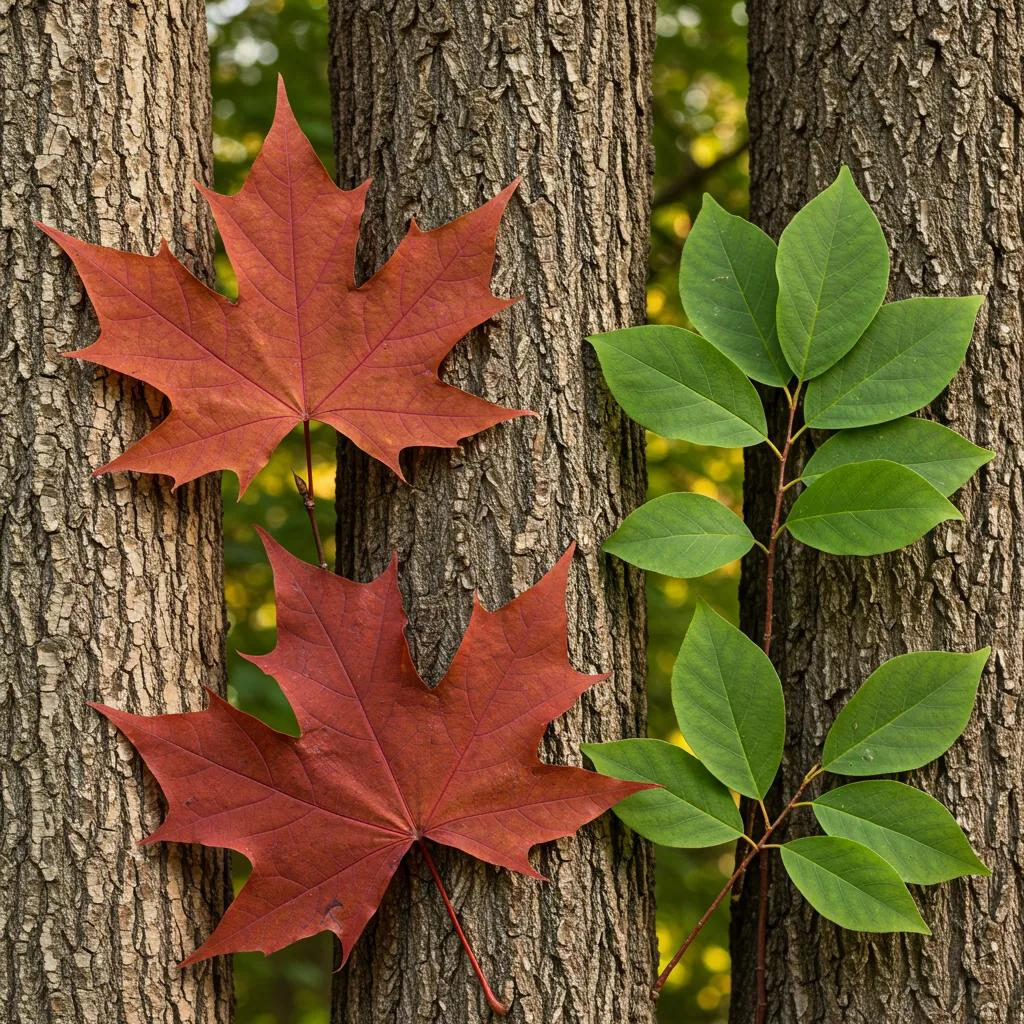
Deciduous trees shed their leaves annually, offering varied leaf shapes, bark textures, and seasonal displays that help reveal their species. This knowledge is vital for targeted pruning and effective disease prevention. Early recognition of these species allows you to anticipate maintenance needs and schedule appropriate care from Henry’s Tree Service when necessary.
How to Identify Red Maple Trees in North Carolina?
The Red Maple (Acer rubrum) is identifiable by its three-to-five-lobed leaves with serrated edges, smooth gray bark when young that develops ridges with age, and clusters of red flowers and samaras in spring. These characteristics aid in precise mapping and care scheduling.
A comparative study highlights the distinct foliage features of various red maple cultivars, offering specific details on leaf size, stomatal density, and nutrient content.
Red Maple Cultivar Foliage Features: A Comparative Study
ABSTRACT: AbstractListenThis study was conducted to compare and define foliage features of select red maple and red maple hybrid cultivars under similar environmental conditions. Nine red maple (Acer rubrum) cultivars, three Freeman maple (Acerxfreemanii) cultivars, and a red maple seedling selection were evaluated in a field study for differences in average leaf area, petiole length, stomatal density, foliar nitrogen (N) content, and chlorophyll content. Leaves of the threeA.xfreemaniicultivars were the largest. Leaves ofA. rubrum‘Autumn Flame’ were the smallest. ‘Autumn Blaze’ had the highest stomatal density. Leaf photographs of each cultivar are included.
Anatomy and morphology of select red maple cultivars, 1995
What Are the Key Features of Sweetgum Trees in NC?
The Sweetgum (Liquidambar styraciflua) is recognized by its star-shaped leaves with five pointed lobes, corky ridged bark, distinctive spiky gumballs in autumn, and a generally pyramidal form. These traits allow for quick identification during planting and maintenance planning.
How to Recognize Yellow Poplar Trees Easily?
Yellow Poplar (Liriodendron tulipifera) features four-lobed, tulip-shaped leaves, deeply furrowed gray bark, and striking tulip-like flowers that appear above the canopy. These distinctive features facilitate early detection and informed care decisions.
What Identifies American Beech Trees in North Carolina?
American Beech (Fagus grandifolia) is identified by its smooth, silver-gray bark, elliptical leaves with prominent parallel veins and toothed edges, and small nutlets enclosed in spiny burrs. These characteristics make it easily recognizable, even in winter.
How to Spot River Birch Trees by Their Bark and Leaves?
River Birch (Betula nigra) is distinguished by its peeling bark, which ranges in color from cinnamon to cream, its triangular, serrated leaves, and its delicate, pendulous catkins. These features ensure it stands out from other riparian species.
What Are the Identification Traits of Common Oak Species in NC?
Oak species (Quercus spp.) are identified by their lobed leaves—the white oak group typically has rounded lobes, while the red oak group has bristle-tipped lobes—along with deeply fissured bark and the characteristic acorn. These traits guide accurate genus and species classification.
Comparing these deciduous species reveals consistent traits that inform tailored pruning, pest management, and seasonal inspections.
| Species | Leaf Shape | Bark Texture | Fruit Type |
|---|---|---|---|
| Red Maple | Three-to-five lobed, serrated | Smooth young, scaly mature | Double samara |
| Sweetgum | Star-shaped, pointed lobes | Corky ridged | Spiky gumball |
| Yellow Poplar | Four-lobed tulip form | Deeply furrowed | Tulip flower |
| American Beech | Elliptical, parallel veins | Smooth silver-gray | Burrs |
| River Birch | Triangular, serrated | Peeling cinnamon-cream | Catkins |
| White vs. Red Oak | Rounded vs. bristle-tipped lobes | Deep fissures | Acorns |
Mastering deciduous tree identification empowers proactive care and supports efficient scheduling of arborist services.
How to Identify Common Evergreen Trees of North Carolina?
Evergreen species retain their foliage throughout the year, offering consistent needle or scale leaf patterns, cone types, and bark characteristics that simplify recognition and winter maintenance. Clear identification informs pest control strategies, storm readiness, and even holiday harvesting plans.
What Are the Identifying Features of Loblolly Pine Trees?
Loblolly Pine (Pinus taeda) is identified by its three long needles per fascicle, thick, plated bark with deep furrows, and large, ovoid cones. These features allow for rapid field identification and the development of pine-specific care strategies.
How to Recognize Eastern Red Cedar Trees in North Carolina?
Eastern Red Cedar (Juniperus virginiana) displays scale-like foliage on mature branches, sharp juvenile needles, fibrous reddish bark, and blue, berry-like cones. These traits ensure precise distinction from pines and spruces.
What Distinguishes American Holly Trees in NC?
American Holly (Ilex opaca) is unmistakable due to its glossy, spiny leaves, bright red drupes (berries), and smooth gray bark. This makes it easy to identify for ornamental planting and for providing winter wildlife support.
Recognizing these evergreens helps in scheduling targeted fertilization and protects trees from cold-weather stressors.
Which Native Trees Are Best for Landscaping in North Carolina?
Native species are ideally suited to local soils and climate, requiring less irrigation and offering superior disease resistance while simultaneously supporting local wildlife and pollinators. Choosing trees adapted to the region reduces maintenance costs and enhances ecological value.
Why Choose Native Trees for North Carolina Landscapes?
Native trees have coevolved with local ecosystems, contributing to improved soil health, reduced water consumption, and providing essential habitats. This guides landscape decisions toward greater sustainability and cost-effective maintenance.
What Are the Top Native Trees for Western NC Mountains, Piedmont, and Coastal Plain?
Mountain regions are well-suited for Fraser fir and tulip poplar; the Piedmont region supports sweetgum and white oak; and the Coastal Plain excels with bald cypress and loblolly pine. Selecting species tailored to these regional conditions ensures optimal growth and health.
How Do Native Trees Support Wildlife and Pollinators in North Carolina?
Native trees like flowering dogwood, red buckeye, and winged sumac provide vital nectar, fruit, and shelter for birds, bees, and butterflies, thereby strengthening local biodiversity and garden resilience.
By incorporating these native selections, homeowners can achieve low-maintenance landscapes that also enrich local wildlife corridors.
When Should You Call a Professional Arborist for North Carolina Trees?
Professional arborist intervention is necessary when trees exhibit signs of disease, pose a structural risk, or when complex pruning and removal tasks are beyond the capacity of a homeowner. Engaging an arborist safeguards your property and ensures the health of your trees. Early consultation can prevent minor issues from escalating into major problems.
What Are the Signs of Tree Disease or Pest Infestation in NC Trees?
Discolored or wilting foliage, cankers, unusual leaf drop, boreholes, and the presence of fungal fruiting bodies are all indicators of disease or pest infestation. These signs warrant prompt professional diagnosis and treatment.
How to Assess Tree Risk and Safety on Your Property?
Factors such as lean angle, cracked bark, root heave, and proximity to structures help determine a tree’s risk profile. This assessment guides homeowners in scheduling hazard mitigation, cabling, or removal services.
When Is Pruning or Tree Removal Necessary for North Carolina Trees?
Storm damage, deadwood, excessive canopy density, or branches encroaching on utilities necessitate pruning or removal. These actions ensure safety and prevent further structural decline.
How Can Professional Tree Care Services Help After Identification?
Certified arborists offer specialized pruning, effective pest and disease management, tailored fertilization programs, and safe removal services. They translate accurate tree identification into effective care plans that promote long-term tree health.
Recognizing these critical triggers ensures you engage expert services at the opportune moment for lasting tree health and property safety.
What Tools and Resources Can Help You Identify North Carolina Trees Easily?
Digital apps, printed field guides, and interactive keys make tree identification accessible, accurate, and engaging. These tools empower homeowners to learn species traits independently before seeking professional care.
Are There Recommended Tree Identification Apps for North Carolina?
Apps such as LeafSnap, PlantNet, and Seek by iNaturalist utilize image recognition technology to match photos of leaves or bark with extensive species databases, providing instant provisional identifications in the field.
How to Use Visual Guides and Interactive Quizzes for Tree Identification?
Pocket-sized field guides and online quizzes guide users through feature comparisons and seasonal traits, reinforcing learning and building confidence in species recognition.
Where to Find Reliable North Carolina Tree Identification Publications and Guides?
Resources like State Extension bulletins, university arboretum brochures, and authoritative field manuals from botanical societies offer in-depth species descriptions and high-quality images, serving as reliable references for accurate identification.
Equipped with these resources, you can validate your field observations and prepare informed questions for arborist consultations.
How Does Identifying Your North Carolina Trees Improve Tree Health and Property Value?
Accurate species recognition leads to tailored care plans, early detection of issues, and enhanced landscape aesthetics. This boosts curb appeal, reduces liability, and maximizes long-term property investments. Understanding your trees translates directly into smarter maintenance and significant cost savings.
What Are the Benefits of Knowing Your Trees for Homeowners and Property Managers?
Proper identification enables species-specific pruning schedules, targeted pest and disease monitoring, and customized irrigation plans. This results in healthier trees, fewer emergency situations, and improved asset valuation.
How Does Proper Tree Identification Lead to Better Tree Care Decisions?
When you align care techniques—such as fertilization, pruning intensity, and pest control—with each species’ unique needs, you prevent damage from over- or under-treatment and extend the tree’s lifespan.
Why Is Early Detection of Tree Issues Important in North Carolina?
Identifying signs of stress, disease symptoms, or pest activity at their earliest stages preserves structural integrity and prevents costly removal or liability claims. This underscores the immense value of routine inspection and collaboration with experts.
By connecting tree identification with effective care and positive property outcomes, you establish a proactive management strategy that safeguards both your investments and the environment.
Henry’s Tree Service combines this identification expertise with certified arborist services for homeowners and property managers in Western Massachusetts and Connecticut. Whether you require a site assessment, a pest control plan, or safe tree removal, our team is ready to translate precise tree identification into professional care solutions that protect your property and enhance your landscape for years to come.